


Description
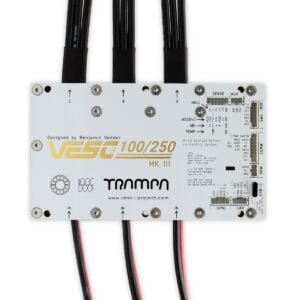
VESC 100/250 MkIII
The Trampa VESC 100/250 MkIII is a powerful, open-source electronic speed controller designed to deliver smooth, precise and customisable performance for electric mountainboards and other electronics projects. Its proven design offers advanced motor control, extensive connectivity and configurable protection features.
Dimensions: 141 x 82 x 14mm
Specifications:
-
Voltage range: 14V–100V, suitable for 4S–22S Li-ion batteries
-
Maximum voltage spikes: 100V
-
Continuous current: 200–250A, depending on mounting, ambient temperature and air or water circulation
-
Burst current: 400A
-
External outputs: 5V and 12V at 1A; 3.3V at 0.5A
-
Motor control modes: DC, BLDC and FOC (sinusoidal)
-
Supported sensors: ABI, Hall and AS5047
-
Maximum supported speed: up to 150K ERPM
Ports and Connectivity:
-
Sensor port for ABI, Hall and AS5047P magnetic precision encoders
-
CAN port for communication with other devices, VESC arrays and UAVCAN
-
PPM port for compatible receivers
-
COMM port supporting communication methods including I²C, ADC, UART and SPI
-
SWD port for chipset access, diagnostics, debugging and real-time data
-
AUX port supplying 5V and 12V to external devices
-
Micro USB connection
Key Features:
-
Accurate current and voltage measurement across all three motor phases using three shunts
-
Regenerative braking
-
Sensored, sensorless and hybrid motor operation
-
Configurable RPM, current, voltage and power limits
-
Input support for PPM, analogue and NRF Nyko Kama Nunchuck
-
USB, CAN and UART communication
-
Adjustable throttle curves and ramping for all input sources
-
Seamless four-quadrant operation
-
Motor revolution, amp-hour and watt-hour counting
-
Real-time data analysis and readouts via communication ports
Configurable Protection:
The VESC includes adjustable protection against:
-
Low and high input voltage
-
Excessive motor current and input current
-
Excessive regenerative braking current, with separate motor and input limits
-
Excessive RPM, with separate limits for each direction
-
Overtemperature of the MOSFETs and motor
